Cortex Protocol
🧠 One memory. Every agent. — user-owned, cross-agent AI memory over the Model Context Protocol.
You own one portable memory, and any AI agent connects to it over MCP with your consent.
Self-host it as a local stdio server — a single SQLite file, your own Gemini key (BYOK),
nothing phones home — and recall does no server-side LLM generation, so the only
runtime cost is your own embedding tokens.
📊 0.932 LongMemEval_S · 0.813 LoCoMo
The only memory system publishing $/question, and the only one at 0.9+ on LongMemEval_S with a cost-efficient-tier reader — a Gemini Flash reader at ~$0.0396/question on LongMemEval_S (~$0.0034/question on LoCoMo). Raw standing: #2 on LongMemEval_S (behind Mastra 0.949), #3 on LoCoMo.
The reader frontier: on the same 500 questions with the same retrieval, a gemini-2.5-flash
reader scores 0.848 at ~$0.0079/question and gemini-3.5-flash scores 0.894 at
~$0.0396/question — +4.6 accuracy points for ~5× the reader cost, same memory system. A
separate output-budget fix at that same reader adds the remaining +3.8 to reach 0.932,
at no extra cost; see the README for why the two are never summed.
Cost footnote: per-question cost is computed from measured token counts at Google's confirmed list prices (paid tier) for the reader model.
Judge disclosure: all Cortex numbers are graded by a gemini-3.5-flash judge, likely more
lenient than the canonical gpt-4o-2024-08-06; the headline run used the same model family as
both reader and judge, so a self-preference bias cannot be excluded and a cross-family re-grade
is planned.
Install
Run the local memory server straight from PyPI — no clone, no build:
Then wire it into any MCP client (Claude Code, Cursor, Claude Desktop, VS Code) with a single
config block — see Connecting Cortex to your agent.
You supply your own key (GEMINI_API_KEY or GOOGLE_API_KEY); get one at
Google AI Studio.
The tools
The stdio server exposes six agent-facing tools:
| Tool | What it does |
|---|---|
memorize(content, kind?, tags?) |
Embed + persist one durable memory (optionally one of six kinds and short tags). |
recall(query, limit?) |
Hybrid dense + BM25 (RRF) retrieval; returns ranked raw memories, no LLM generation. |
recall_about(entity, limit?) |
Exhaustive per-entity dossier from the entity graph — a pure keyed read. Requires CORTEX_GRAPH=1. |
recall_timeline(since?, until?, limit?) |
Dated events in chronological order from the episodic layer. Requires CORTEX_EPISODIC=1. |
list_memories(limit?) |
The most recently saved memories, newest first. |
forget(memory_id) |
Delete by full id or an unambiguous short-id prefix (ambiguous prefixes are refused). |
Benchmarks — per question type
Split by LongMemEval_S question type, Cortex — the only cheap-reader system in the field — holds the top tier of the premium-reader systems, and leads on single-session-assistant and multi-session recall:
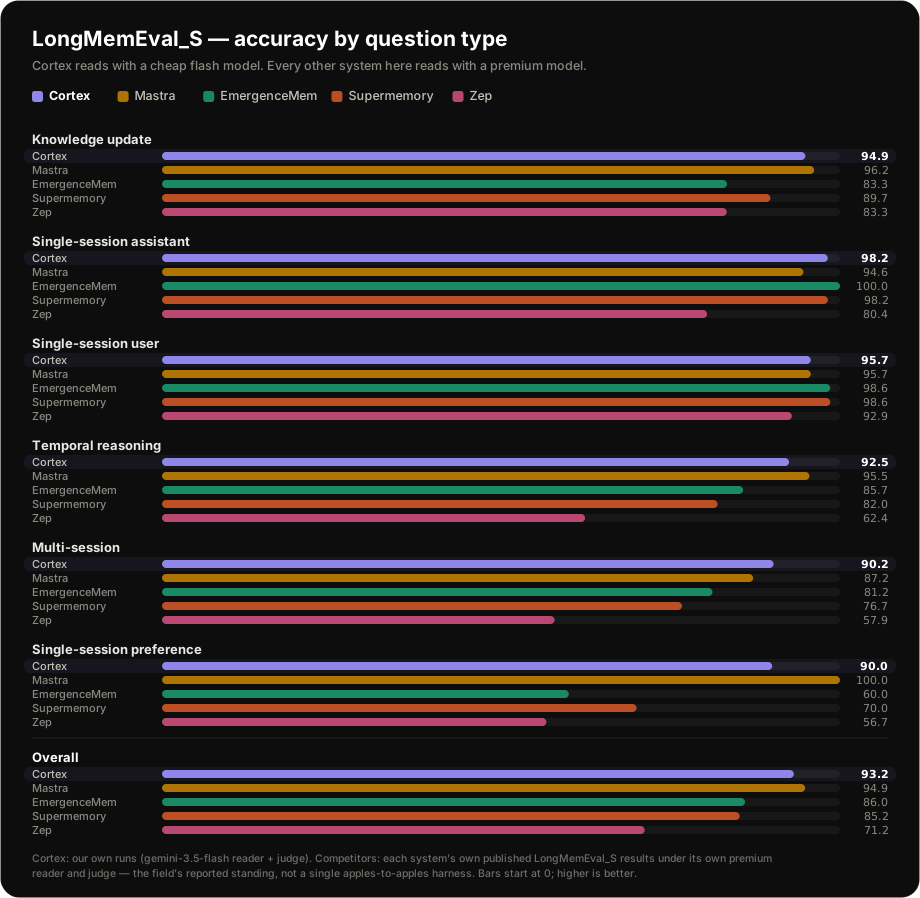
Competitor rows are each system's own published results under their own premium readers and judges (not a single apples-to-apples harness). The full results table, cost-per-question, and reproduce commands are in the README.
Where next
- Architecture — a contributor-facing tour of the engine: the provider abstraction (BYOK), the persistent store, the hybrid retrieval core, and the opt-in write-time enrichment layers.
- Decades-scale — how recall scales from a personal SQLite store to a decades-long, multi-user hosted store (pgvector HNSW, AlloyDB ScaNN), with measured latency.
- API reference — the
CortexMemoryengine and theLLMProvidercontract for writing your own provider. - README — the full project overview, results, and quickstart.
- Runnable examples —
examples/quickstart.py(memorize + recall, offline) andexamples/custom_provider.py(write your own provider).